
There seems to be a great propensity within exercise professionals to diagnose, and the unfortunate thing is that a lot of the time they don’t even realise they are doing it.
At a recent training sessions I noticed that a lot of instructors were quite comfortable telling their partners that they had ‘winged scapula’.
Now you could argue that that is a generic term for having shoulder blades that stick out from your rib cage but it is the technical term for shoulder blades that stick out from your back because of a neurological issue.
If a member of the public in a class took that phrase to their doctors we would be faced with two scenarios:-
A – the GP would panic they had missed a diagnosis of a neurological condition,
B- the GP would have a wry smile and think ‘Exercise professional talking bollocks again.’
Either scenario is not great for the professional involved and both leave the member of public doubting the knowledge of the experts.
To be fair, when it was pointed out to the exercise professionals that winged scapula was a medical sign of the long thoracic nerve not functioning, which is quite a rare medical disorder, they were horrified they had ever been introduced to the term. When shown a picture of a genuine winged scapula, none of them had ever seen it.
Let’s compare two pictures.
 This is a genuine winged scapula caused by the long thoracic nerve not working. This nerve innervates the serratus anterior muscle and with it not contracting and holding the shoulder blade (scapula) to the rib cage, the scapula sticks out if pressure is put on the extended arm.
You can imagine that this would display itself during press ups.
There is a difference between the person whose shoulders blades stick up in a press up because they are not used to contracting the serratus anterior and the person who can’t contract that muscle. (It’s the subtle difference between ‘you have a winged scapula’ and ‘your scapula are winging’ although the second phrase is usually used by people who don’t appreciate the difference and have grammatically stumbled on the phrase)
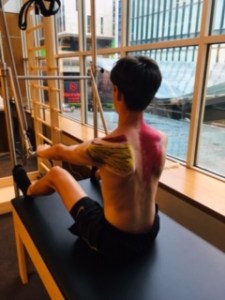
This second picture is from a site aimed at exercise professional. It is 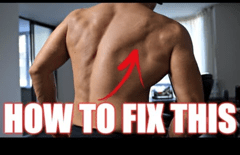 claiming that this is a winged scapula and that you can fix it with their exercises. There exercises engage the Serratus so would pull the scapula in but you can see that the person’s scapula isn’t winging, in fact the arrow points to a depression on their back where their scapula is, over hung by the development of their Traps. Is it any wonder that people get confused.
To further add to the confusion the same site overs to fix something else that isn’t a problem.
Here we can see someone with their finger tips 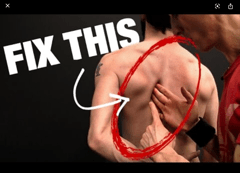 inserted between a scapula and a rib cage – this must be a problem! Surely this is winging?
No, look at the pose. The man has his hand around behind him in the small of his back. This is the pose that body workers use to release the shoulder blade so that they can work on the muscles around it. If your shoulder blade didn’t come away from your rib cage in this pose you would never be able to get into the pose, your arm wouldn’t go behind you.
Maybe its just trying to demonstrate the problem on someone whose nervous system is functionally properly. I think they would have been better using a press up and asking him to relax his serratus. If you can contract it, you can relax it and allow your shoulder blades to splay out (not wing).
The bottom line is that words are powerful. If you have taken a technical term from another profession then you need to be careful how you use it. Particularly if the person you are using it with is likely to go across professions (like the public).
The public’s understanding on how their body works is often dubious. The professions don’t need to add to the confusion by not appreciating what they are communicating.
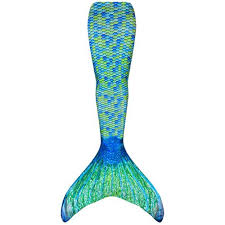 Almost everyone describes a merperson’s tail as seen in this picture. (I was going to use the statue of the mermaid from Copenhagen but it has legs). The merperson has a lower half that is covered in scales and the fins of the tail are in the same orientation as the arms – they stick out to the sides.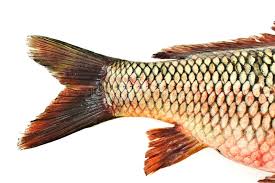
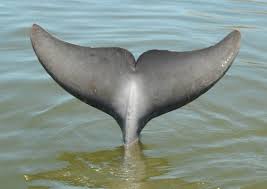 and back. Aquatic mammals have tails that look like this and the movement in the water is up and down rather than side to side.

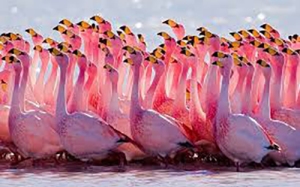
 Peter Pan. It’s used to describe the way the characters stands – arms akimbo. It describes the action of standing with your hands on your hips with the elbows splayed outwards.
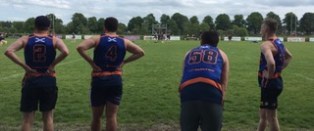 You can see three players with arms akimbo and a fourth player with their hands on their knees.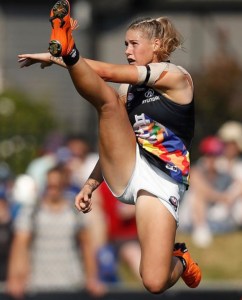
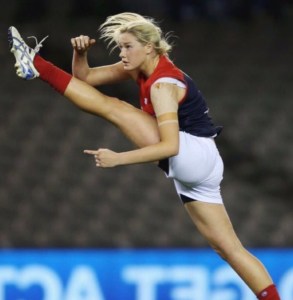
 same but when we ascend rapidly the pressure inside the ear becomes greater than the cabin pressure and the ear drum is forced outwards. As we descend the opposite happens with the pressure in the cabin becoming greater than that in the inner ear and the ear drum is pushed inwards. This affects its ability to move when sound waves hit it and so your hearing become muffled and it might be painful.
 matters of the heart. Whilst there is a large window of opportunity for education around the sexual organs – you only have to listen to the popular pod cast “My Dad wrote a porno” to realise there are big holes in some people’s anatomical knowledge of that region, I thought I would go with something a little more romantic (maybe I’ll cover the other angle on Patreon).
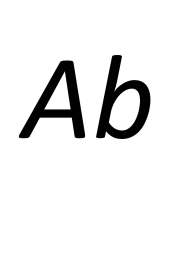 Abducens come from the Latin Ab, away and Ducere, to lead. Abductors move things away from the midline of the body. The abducent nerve gets its name because it supplies the lateral rectus muscle of the eye, which turns the eyeball outwards. It was once known as musculus amatorius because of its contribution to proving the sidelong glances of lovers
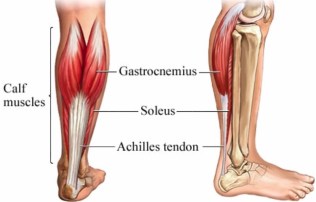 meaning the belly of the leg, and the Soleus; named not from the Latin for sole as the muscle does not attach to the sole of the foot but named after the latin Pleuronectes solea, a sort of flat fish that the muscle resembles in shape. These two muscles give your calf the shape that it is and both insert into the calcaneal tendon which attaches to the calcaneus, which most of you will know as your heel bone. It is arguably connected to the plantar fascia which runs into the sole of the foot but traditionally these have been viewed as two different structures.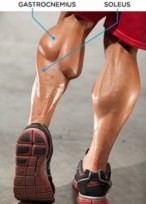
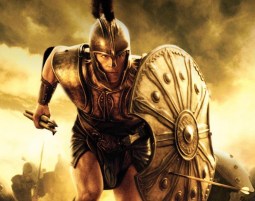 developed afterwards or Hollywood blockbusters. The most common myth is that he was invincible, made so by his mother dipping him into the river Styx when he was a baby. She held onto him by his ankle and hence this part of his body was vulnerable. It was literally his Achilles heel, the term we now use for a weakness that makes someone vulnerable. Achilles died during the Trojan wars when Paris, one of the Trojan princes shot him in the heel with an arrow. (We need to gloss over the fact that many statues and paintings depict multiple arrows in Achilles at the time of his death and also the fact that Paris started the whole Trojan war when he took Helen of Troy away from her husband, the King of Sparta, after being promised her hand in marriage by Aphrodite after he judged the Godess the winner of a beauty competition between the Greek gods. Greek myths are never simple)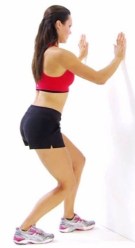
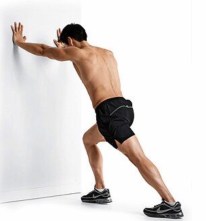 The more common stretch that you see people doing is the gastroc stretch. This is the one where the back leg is straight. This is because the gastrocnemius actually inserts onto the femur above the knee joint. If you bend the leg then you release one end of the muscle.
 anatomyfundamentals.com