

I was going to post this article before Christmas but that seemed a bit too much like ‘being a kill joy’ so having over consumed during the festive period you can now read all about what it did to your body.
Drinking is something most people do during the Festive period. Scientists argue as to why we drink – there is even the suggestion that it is the foundation stone of human civilisation. To have pubs you have to have agriculture and cooperative working between several group of people and some form of economy. There is some talk of reward centres in the brain but given the often bad effects of excessive drink, we do not seem to learn as a society and we regularly go out and over indulge.
We should all know that alcohol comes in units, but what is a unit? In the UK it is 8g (about 10ml) of pure alcohol. This is the amount of alcohol that your liver can detoxify in 1 hour (yep, alcohol is a toxin and your liver is your own detox unit – you do not need to live on blueberry smoothies for a month). This equates to one 25ml measure of spirit, a third of a pint of beer and around half of a glass of wine. If you drink any more than this then you are going to start to feel the effects of alcohol.
Alcohol can be absorbed through any of your mucus membranes (which has led to some very strange fraternity rituals in USA) so its absorption starts as soon as it enters your  mouth. Fizzy things gets absorbed quicker which explains why Champagne and Prosecco can go straight to your head. It continues to be absorbed through your stomach but most will be absorbed in your small intestine. Once in your blood stream you can start to feel the effects.
What are those effects?
The first one is you begin to feel relaxed.
This is because alcohol binds to GABA receptors. GABA (Gamma Amino Butyric Acid) is a neurotransmitter in your brain. Its exact role is complicated but it increases the amount of dopamine and serotonin in your system. By binding to the same receptors, alcohol has the same effect; you feel relaxed and maybe sleepy.
Once in your brain, alcohol can also start to effect the feedback with your prefrontal cortex, the part of your brain that deals with analysing future consequences. Your inhibitions disappear and you are more likely to partake in activities that you wouldn’t consider if you were sober. Continue to drink and it can start to effect your cerebellum. This ‘little brain’ at the back of your head is responsible for coordination. You start to stumble around and you have to adopt a shuffling wide legged stance to enable you to walk.
The second effect is your need to pee.
Often put down to the volume that you are drinking, this is not the case. How much you need to pee is controlled by a chemical called vasopressin. This is an antidiuretic and works with your kidneys (another detox organ) to regulate the production of urine. Alcohol switches off the production of vasopressin and therefore you need to pee all the time.
The last effect is the hangover.
No one is 100% sure what causes the hangover. There was some belief that it was an imbalance of electrolytes but studies have shown similar levels in those with and without hangovers. There is some belief that it is some residue in the drink and the higher quality the drink you consume the better you will feel afterwards. There is some belief that certain combinations of drink can produce more of a hangover than others i.e.’don’t mix grain and vine’. Its probably due to dehydration. you just need to rehydrate. You can’t sweat it out by going for a run, raw eggs have no effect, although, as a resident of Scotland I do have to say I have seen Irn Bru perform wonders.
The fact is that alcohol is a toxin and you need to be aware of that when you introduce it into your body. 1 in 3 men, and 1 in 6 women will develop a health issue that is related to drink.
You need to decide if you want to drink it or not. Cheers.


 and spreading good news. In fact the word angelic sums up that sort of image. I prefer this sort of depiction in the painting by Reni. Much more feisty. Either way, they always have wings. I had an interesting discussion with an artist about this, who suggested it was more to do with early painting techniques. It used to be hard to judge whether a small figure high up in a picture was actually angelic or simply far away (I’ll wait while you all think about Father Ted). This problem could be solved by adding wings which then made it clear to the viewer how that figure should be viewed.






 This is the cast of a four year old child. you can see the roughness of the plaster that is the same as many of the other specimens. Now look at the top of the child’s head. That looks like very smooth bone. When we got back to the UK I did a little research and found out that the 86 original plaster casts have been through a CT scanner. The remains of that child are enclosed within the plaster; the smooth surface at the top is the actual cranium. We did find multiple copies of the same casts around the city so it may well be that the originals containing human remains are not actually on display but these are the items that people come to see in Pompeii – why? What is it that attracts us to human remains?
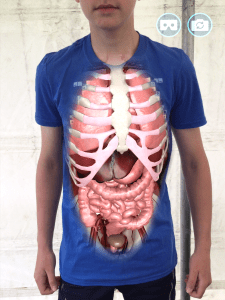 organs. There is no denying that this is a magic bit of kit and this week it took a big step forwards. Through some fancy technology, the t shirt can now show your actual heart beat! You can put on the shirt and see your resting heart beat, run around the block and see the increase. I can’t wait to show this to a class room of kids. It blows their mind when they see the organs anyway, to see it actually responding to what they do is going to be great!
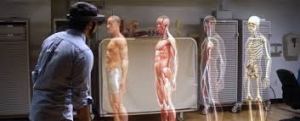 headsets looking at anatomical models that were not there. You could push your face in towards the model and look at what was inside the chest. You could look down through the layers of someones abdominal wall and see the layers of muscles. Did it help me understand it any better than models and books – not sure.
 We have run several successful workshops on modelling facial muscles with wax. Its not really a technology nowadays but I’m sure at some point, back in the day, it would have been thought of as ground breaking.
 To keep it simple, the joint is not a hinge joint as it is often described. The articulating surface of the femur is a lot larger than the articulating surface of the tibia in the lower leg. As the joint hinges it also has to slide to ensure these surfaces stay in contact with each other. It is the role of the cruciate ligaments, both anterior and posterior, to ensure that the femur does not slide too far in either direction
 the back of the joint. If your knee is fully flexed then your menisci are quite safely held at the back of the joint. How many people do you know who can get their foot all the way to their bottom? If your leg isn’t fully flexed then the menisci are in the process of moving backwards.
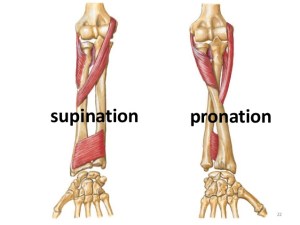 In anatomy we have this position called ‘anatomical position’. This is someone standing up with their hands by their sides and their palms facing forwards. Anything towards the mid line is called medial, anything towards the edge of the body is called lateral. Your thumb is lateral, your pinkie is medial. Doctors use this language to ensure they are talking about the same part of the body. It does not matter the position you are in, everything is referred to as if it were in the anatomical position. Your thumb will always be lateral, even if you turn your hand around.
 anatomyfundamentals.com