
Last week I was at a concert (how on earth is she going to relate this to anatomy?)
Whilst the way in which we hear is fascinating and complex, I actually wanted to talk about public engagement and getting your message across.
We have all heard the message about how you should lift with your legs, keep your back straight and bend at the knees and hips. It must be one of the most prominent messages about people’s anatomy, and yet, does anyone ever listen to it?
I watched as the young people cleared away the instruments. This included lifting several heavy percussion instruments onto a stage that was about three foot high. One of the lifts involved 8 people.
The kid at the left hand end was the only one that I saw keeping a straight back and lifting as instructed. (This is because he has had anatomy forced upon him at home)
Some of the lifting techniques being displayed were truly wince inducing and I’m sure they will be making physical therapists wealthy for a long time to come.
Why are we so bad at taking in messages that are meant to do us good?
It is the eternal battle of public engagement. Engage without preaching. Make what ever it is fun and relevant.
Anatomy should be so easy to make relevant – we all have it.
As we enter the International Science Festival I wonder if we will be able to get our message across any better than those people who deliver manual handling courses.


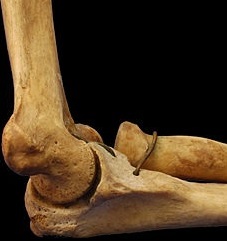 e humerus. The whole structure is surrounded by many ligaments that stablise the joint. It is not designed to have any sideways motion.
 You sometimes get asked some funny questions when you are an anatomist, an exercise professional and a trainee massage therapist. They usually start with ‘I’ve got this pain here…’ and I love the opportunity to do a bit of detective work and try and identify the issues although I always start my answers with ‘I’m not a medic or a physio but…’
 enough to take part in a wax modelling session where we produced a model of a face. This started from the skull and built up each individual muscle. Some of the muscles you can’t see in the picture and obviously you wouldn’t be able to see any of them once a skin layer was applied but their existence beneath the surface makes the face what it is.
 An ecorche in the ‘Dying Gaul’ pose. Every muscle can be seen, it is a great study guide and I have always been impressed by it.
 that have legs or arms as well as wings. It appears anatomy isn’t so important in this realm.
 with no thought as to how they would actually work.
 The language of anatomy can be something that either entices students in to learn more or can act as a really barrier to their engagement. The vast majority of us are no longer taught Latin or Greek in school and so the terms that were maybe in everyday usage a few centuries ago are now archaic and their meaning lost to many. Yet if you know the meaning of these words the anatomical names suddenly make a lot more sense and you can even work out what things might be called.
 I recently managed to apply this knowledge the other way. Whilst on holiday I read Robert Harris’ new book Conclave. (Very good book – you should read it.). As the title suggests this was about the election of a new pope and there were a lot of use of the word genuflect. I didn’t know what that meant. I did know that the blood vessels around the knee are called genicular arteries and veins so genu could well mean knee. Flec relates to flexion. Was genuflecting the practice of bending ones knee? The little bob that priests give infront of alters. Spot on!
 anatomyfundamentals.com